Selling old paper money in San Francisco
Old bills from books, safes and desk drawers. Each note is checked for type, series, serial number and condition, then priced on what collectors pay now.
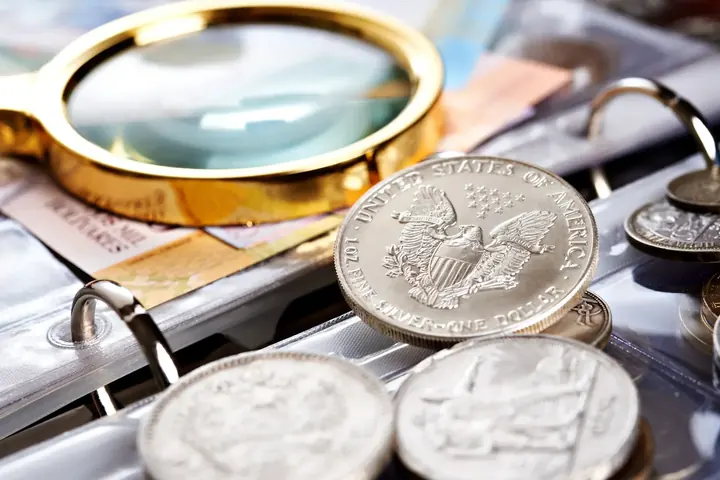
Old money in a gold town
California was a gold coin state for decades. Many Californians distrusted paper money after the Civil War and kept using gold coins long after the rest of the country switched to bills. That makes early California paper scarcer than you might expect, and national bank notes from San Francisco and other California banks are popular with collectors.
We also see the usual mix from Bay Area estates: silver certificates, two dollar bills, Hawaii overprint notes from World War II and foreign notes from travel.
Types of old U.S. notes
The seal color and the words across the top tell most old notes apart.
- Silver certificates: blue seal
- United States notes: red seal
- Gold certificates: gold seal, recalled in 1933
- Federal Reserve notes: green seal
- Large size notes: bigger bills printed before 1929
- National bank notes: a local bank's name on the face
California national bank notes
From 1863 to 1935, banks across the country printed currency with their own name and city. California banks issued fewer notes than eastern banks for many years, partly because the state preferred gold coin. Notes from San Francisco, Oakland and smaller California towns are popular with collectors. Keep them flat and bring them in.
Star notes and serial numbers
A star next to the serial number marks a replacement note, and stars are scarcer than regular notes of the same series. Very low numbers, solid numbers and ladders also attract collectors. We check every note.
Condition and handling
Folds, tears, stains and missing corners lower a note's value. The best prices go to crisp, square-cornered notes. Resist the urge to press, tape or wash an old bill.
Confederate and Civil War era notes
Confederate notes made their way west with Southern families after the Civil War. Many are common, and many more are later reproductions printed as souvenirs. Real ones in fair shape still interest collectors. We examine paper, printing and serial numbers and tell you what we find.
Paper money we buy
- Blue seal silver certificates
- Gold certificates and red seal notes
- Large size notes from before 1929
- National bank notes from California banks
- Fractional currency from the 1860s and 1870s
- Confederate notes
- Star notes and fancy serial numbers
- Older foreign notes with collector value
How paper money is priced
A note's value comes from its type, series, signatures, serial number and condition. A worn 1957 silver certificate sells for a little over face. A crisp large size note or a gold certificate can sell for many times face.
We look at every note under good light, check recent sales and write down what we would pay.
Further reading: Counterfeit coins and how to spot them
Common questions
- What are Hawaii overprint notes?
- Notes printed with HAWAII during World War II. Many are common, but crisp ones and some types carry collector value.
- Do you buy fractional currency?
- Yes. These small notes from the 1860s and 1870s carry collector value, especially in good condition.
- Should I flatten old bills?
- No. Bring them as they are. Pressing and taping can lower the value.